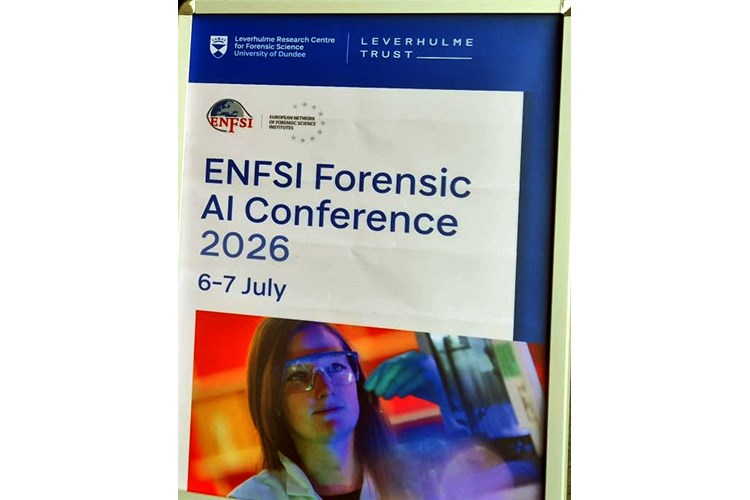
An international conference dedicated to the application of artificial intelligence in forensic science was held in Dundee, Scotland. Experts from the Centre attended the event to keep abreast of the latest technological developments and to examine the professional, legal and ethical challenges associated with the use of artificial intelligence in forensic examinations.
FOTO: FSC "Ivan Vučetić"
The ENFSI Forensic AI Conference 2026 took place in Dundee, Scotland, from 6 to 7 July 2026. The conference brought together leading European experts in forensic science, law and information technology to exchange knowledge and discuss the growing impact of artificial intelligence on forensic examinations.
The “Ivan Vučetić” Forensic Science Centre was represented by Jelena Kozar Filić, Chief Expert for Quality Control and Accreditation, and Sunčica Kuzmić, Digital Forensics Expert.
The conference programme covered a wide range of topics relevant to the development of modern forensic science, organised into several specialised areas.
In the field of forensic audio and speech analysis, presentations addressed language detection in forensic audio recordings, the use of artificial intelligence systems for audio enhancement, and the challenges posed by generative models. The programme also examined the use of machine learning in automated speaker identification tools, as well as the detection of manipulated and deepfake audio recordings through a combination of artificial intelligence tools and traditional forensic methods.
Within the area of image analysis and pattern recognition, participants were introduced to solutions for the automated analysis of cells under a microscope, the identification of individuals based on tattoos, and age estimation using artificial intelligence models.
In the field of biological, chemical and other physical evidence, particular emphasis was placed on the responsible use of artificial intelligence in the analysis of biological traces and on the identification of ignitable liquids in fire investigations.
Participants were also introduced to new models for software reverse engineering, as well as opportunities to automate workflows in digital forensics laboratories.
In addition to technological solutions, a substantial part of the conference focused on legal and ethical issues, the validation of artificial intelligence systems, and the challenges associated with presenting and challenging the results of their use in court proceedings. This topic is particularly important for the Centre, as it supports the maintenance of high quality standards and the timely adaptation of quality management systems and accreditation procedures to emerging technologies.
Participation in international professional events of this kind reflects the Centre’s commitment to continuous professional development and the implementation of advanced forensic methods. The exchange of knowledge and experience with colleagues from European forensic institutions helps ensure that Croatian forensic science keeps pace with the latest scientific and technological developments, while preserving the reliability, transparency and scientific validity of forensic findings in the digital age.
Page