Forensic biology
Forensic examination of biological traces of human origin encompasses various methods, including serological and microscopic techniques. Notably, molecular-genetic analysis is the most important, as it enables the identification of the individual. This method analyzes the DNA molecule, focusing on differences in its sequence and the number of repetitions of its nucleotide bases. The result is a DNA profile unique to each individual, forming the basis for the application of molecular genetics in forensics.
The forensic material is examined visually and by modern instruments used to detect forensic traces. Preliminary tests based on chemical, physical, or enzymatic reactions are used to exclude “false” traces from further analysis, followed by confirmatory tests to verify the human origin of traces such as blood, semen, or saliva.
Molecular-genetic analysis begins by extraction of DNA from cells and removing molecules and contaminants that could interfere with downstream process. The quantity and quality of DNA (degree of degradation) in a sample are determined by real-time polymerase chain reaction. Targeted DNA sequences are amplified from samples with sufficient quantity of DNA using polymerase chain reaction. This enables the determination of a DNA profile even from highly scarce samples.
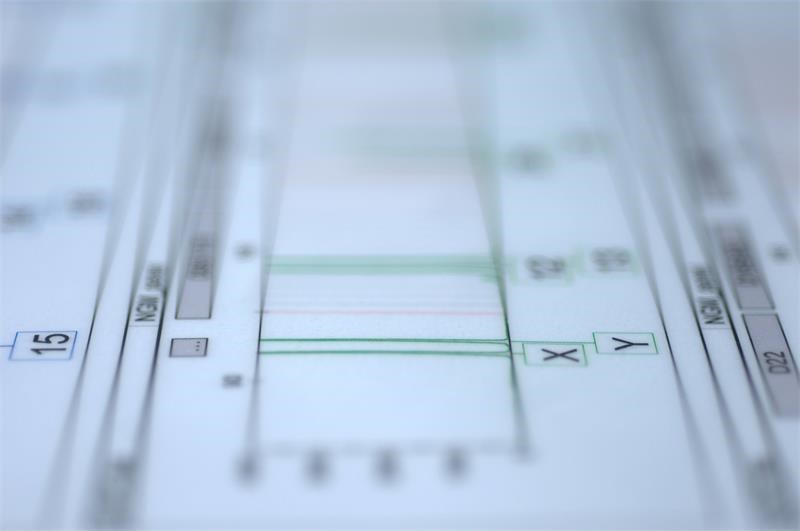
The separation of amplified DNA fragments is carried out by capillary electrophoresis. This analytical technique relies on the principle that DNA fragments of varying lengths migrate at different velocities when subjected to a direct-current electric field. Fluorescent labeling enables the detection of DNA fragments. Using specialized software, to each detected DNA fragment a numerical value is assigned corresponding to its length. The combination of all detected DNA fragments, displayed as an electropherogram, represents the final result of the analysis — the unique DNA profile of each sample.
Continuous research in molecular biology, specifically improvements in the methods of genetic marker analysis, lead to enhanced sensitivity and enable the analysis of scarce biological samples (with DNA concentrations of less than 15 pg/μl). Through implementation of new methods, the Centre’s laboratory for forensic biology is keeping pace with international standards.
The ultimate goal of forensic examination of biological traces of human origin is to determine the identity of the person from whom the trace originates. For this purpose, the DNA profile of a crime scene trace is compared to the reference sample DNA profile. Reference samples can be blood or oral epithelium cells taken from a person of known identity. A match between the DNA profile of the trace and the DNA profile of the reference sample indicates that the trace originates from a specific individual.
The obtained DNA profiles are entered into the DNA Database for the purpose of verification, comparison and storage of DNA profiles. The Database was founded in 2001 and contains DNA profiles of criminal offenders, victims, unidentified traces from crime scenes, and DNA profiles of unidentified human remains.
In addition to biological trace identification, Centre’s Forensic Biology laboratory also conducts DNA paternity testing and identification of unidentified human remains.
In addition to nuclear DNA fragment analysis, sequencing of mitochondrial genome (mtDNA) control region is succesfully implemented. The analysis of mtDNA has significant forensic application due to its circular nature and high copy number when compared to nuclear DNA. It is applied most commonly in forensic examination of unidentified human remains. The Croatian mtDNA population database has become part of the global forensic mtDNA profile database - EMPOP (European DNA Profiling Group Mitochondrial DNA Population Database) thus enabling statistical calculations of mtDNA sequence frequencies used in experts’ reports.
The Forensic Biology laboratory also performs forensic examination of biological traces of animal origin by sequencing mitochondrial (mtDNA) markers and microscopic analysis of animal hair morphology.
Forensic Science Centre “Ivan Vučetić” successfully collaborates with countries in Europe and worldwide through the international exchange of DNA profiles.
Since 2000, the Centre’s Forensic Biology laboratory has successfully participated in annual independent international proficiency tests. Together with the accreditation according to HR EN ISO/IEC 17025/2017 standard, this ensures that forensic examinations of biological traces are conducted in concordance to internationally defined methods and protocols.
Accredited method:
- Detection of polymorphisms of gene loci
- Flexible scope of accreditation
Služba bioloških i kontaktnih vještačenja 113
Department of biology and fibres 113
Područje bioloških vještačenja 113/1
Division of biology 113/1
Department of biology and fibres 113
Područje bioloških vještačenja 113/1
Division of biology 113/1
| Vrsta ispitivanja Type of test |
Materijali/Proizvodi Materials/Products |
Tehnika ispitivanja
Test technique
|
Metoda ispitivanja Test method |
U primjeni od In use from |
|---|---|---|---|---|
| Molekularno-genetska analiza Forensic DNA analysis |
Tragovi biološkog podrijetla (krv, sperma, slina, epitelne stanice, kosa, dlake, meko tkivo, kosti, zubi i dr.) Various biological samples (blood, sperm, saliva, epithelial cells, hair, tissue, bone, tooth etc.) |
Preliminarni i dokazni testovi za tjelesne tekućine
Presumptive and confirmatory tests for body fluids Serološki test
Serological test
Mikroskopija
Microscopy
Izolacija i pročišćavanje DNA
Isolation and purification of DNA
Utvrđivanje količine DNA Quantification of DNA Umnažanje genetskih biljega
D10S1248, vWA, D16S539, D2S1338, D8S1179, D21S11, D18S51, D22S1045, D19S433, TH01, FGA, D2S441, D3S1358, D1S1656, D12S391,
D7S820, CSF1PO, D13S317, TPOX, D18S51, D5S18, SE33, Amelogenin, DYS576, DYS389I, DYS635, DYS389II, DYS627, DYS460, DYS458, DYS19, YGATAH4, DYS448, DYS391, DYS456, DYS390, DYS438, DYS392, DYS518, DYS570, DYS437, DYS385, DYS449, DYS393, DYS439, DYS481, DYF387S1 i DYS533 PCR based multiplication of genetic markers -short tandem repeats (STR) Kapilarna elektroforeza Capillary electrophoresis Analiza rezultata računalnim programima Software data analysis |
Vlastita metoda/RU-113/1-31, v5.1, 2024-07-24 Detekcija polimorfizama genetskih biljega In house method/RU-113/1-31, v5.1, 2024-07-24 Detection of genetic markers (STR) polymorphism |
29.04.2015. |